Every vowel you have ever spoken was made the same way: a source of sound (your vocal folds,
tapping the air in your throat a hundred-odd times a second) shaped by a filter (the air-filled
tube of your throat and mouth, which rings at its own preferred frequencies). This source–filter model
is the foundation of almost all speech processing: pitch tracking, formant analysis, linear prediction, codecs,
synthesis. Before any equations, let's build the intuition from something you already understand: hitting things and listening.
The path through this page
Strike it and listen: every object has a sonic fingerprint, its impulse response
Companion to Vocal tract, live · turn your sound on: most demos play audio
01 · An analogy
Strike it, and listen.
Close your eyes. Someone knocks on a wooden table, then a steel pipe, then a glass window. You name each one instantly,
even though the knock was the same each time: the same knuckle, the same force, the same brief instant of contact.
The knock only lasted a few milliseconds. Everything you heard afterwards, the dull thud or the long bright ring, came from
the object answering the knock in its own way.
Try it. Click a slab to strike it, then change what you strike it with.
Strike with:
What you heard: the first 0.4 s of the sound
Its spectrum: the object's resonances (0–8 kHz)
Click any slab above.
What makes them sound different?
A struck object vibrates in a handful of natural modes, each a pattern of motion with its own frequency, and
each dying away at its own rate. The spectra above show them as peaks. Two physical properties set almost everything:
Where the peaks are: stiffness, density, shape
Stiff, light materials vibrate fast (high modes). Heavy, floppy ones vibrate slowly. Steel and glass carry sound at
roughly 5,000–6,000 m/s, wood at roughly 3,000–5,000 m/s along the grain. Size and shape matter as much as material: a longer bar of the
same steel rings lower. The mode frequencies are usually not whole-number multiples of each other, which is why a struck plank has no clear musical pitch.
How long they ring: internal friction (damping)
Every cycle, a little vibration energy turns into heat. Metal loses very little per cycle and rings for seconds.
Wood, with its fibres rubbing against each other, loses most of its energy in a few tens of milliseconds: a thud.
Stone is heavier still and even more damped. In the spectrum, fast decay shows up as broad peaks, long ringing as sharp ones.
And the striker? The hard hammer touches for a fraction of a millisecond, delivering an almost perfect instantaneous
kick that excites every mode, low and high. The soft mallet stays in contact for a few milliseconds, which is too slow
to shake the high modes, so you hear the same object, darker. Notice what did not change when you switched
strikers: the positions of the peaks. They belong to the object. The striker only decides how strongly each one gets excited.
Hit a system with a perfectly sharp, instantaneous kick (an impulse) and whatever comes out is its
impulse response, \(h(t)\). For linear, time-invariant systems it is a complete fingerprint: if you
know \(h(t)\), you can predict the output for any input \(x(t)\) by convolution,
\(y(t) = x(t) \ast h(t)\). Equivalently, in frequency, \(Y(f) = X(f)\,H(f)\): the input's spectrum,
reshaped by the system's resonances. (See the convolution tutorial for why.)
That last formula already contains the whole of this page. The striker is \(X(f)\), the source.
The slab is \(H(f)\), the filter. What you hear is their product, and your ear is remarkably good at
telling the two factors apart.
Impulse responses are everywhere
Once you look for it, “excite it briefly, then listen to how it answers” is one of the most common ways people and machines probe the world.
👏
A clap in a room
Clap once in a bathroom, a classroom and a cathedral. The clap is the impulse; the reverb tail is the room's impulse response. The same sentence convolved with a small-room and a large-hall response (from the reverb notebook):
🚂
The wheel-tapper
Railway workers once walked along stationary trains tapping every wheel with a long hammer. A sound wheel rings clearly; a cracked one gives a dull, short note. Its impulse response changed because its damping changed.
🩺
A doctor's chest percussion
Tap two fingers on the chest: air-filled lung sounds hollow and resonant, fluid or a solid mass sounds dull and flat. The same logic tells you whether a watermelon is ripe, or finds the stud behind a plaster wall.
🎸
A guitar body
Tap the top of an acoustic guitar and you hear its body resonances directly. When the strings play, those same resonances colour every note. Luthiers tune them by tapping and listening as they carve.
🔔
A bell
A bell is an object designed so that its modes line up almost harmonically. Bell founders shave metal from the inside until the tap sounds right.
🗣️
Your own mouth
Open your mouth into an “ah” shape and flick your cheek or tap your throat gently. You hear a faint hollow “tok” whose pitch changes as you shape different vowels. That is your vocal tract's impulse response.
02 · From a tap to a tone
Now tap faster.
One strike gives one ring. What if you strike the same slab again and again, at a steady rate? At two taps a second you
hear a rhythm: tap, tap, tap. Speed up. Somewhere around 20 taps per second something remarkable happens:
your ear stops hearing separate events and hears a single continuous buzz with a pitch. The pitch is the tapping rate.
Slab:
Time: taps (blue ticks) and the sound they produce, first 0.25 s
Spectrum: ■ the sound ■ the slab's own resonances (its single-tap spectrum)
Look at the spectrum as you raise the rate. This picture is the heart of the source–filter model, so it deserves a slow read:
The taps set the pitch. A tap train repeating every \(T\) seconds is periodic, so its sound can only contain
frequencies at whole-number multiples of \(1/T\): the harmonics. The spectrum turns into a comb of lines, spaced exactly
at the tap rate. Double the rate and the lines spread twice as far apart; the pitch goes up an octave.
The slab sets the colour. The heights of those lines follow the slab's resonance curve (red). Lines that fall near a
resonance are loud; lines between resonances are weak. Swap wood for steel at the same rate and the pitch stays the same while the timbre changes completely.
The two are independent. The tapper knows nothing about the slab, and the slab doesn't care how often it is tapped. What you hear is
simply comb × resonance curve.
A periodic train of impulses, pushed through a resonant object, produces a harmonic spectrum (lines at multiples of the
tap rate) whose envelope is the object's resonance curve. Pitch comes from the excitation; timbre comes from the resonator.
03 · The analogy, applied to speech
Your voice does exactly this.
Map the pieces across, one to one:
The tapper → vocal folds
Air from the lungs pushes the vocal folds apart; they snap shut again, over and over. Each closure sends a sharp pressure kick into the air above:
a tap. Men's folds typically tap about 85–155 times a second, women's about 165–255. That rate is the fundamental frequency, \(F_0\), the pitch of the voice.
The slab → vocal tract
The throat, mouth and (sometimes) nose form an air-filled tube about 17 cm long in an adult male. Like any object it has natural resonances.
For a tube these are called formants (\(F_1, F_2, F_3, \dots\)), and they are what make an “ee” sound different from an “ah”.
Swapping slabs → moving your tongue
Unlike a wooden plank, your vocal tract is reshapeable. Every time you move your tongue, jaw or lips you are, in effect, swapping in a new
“slab” with different resonances, several times a second, while the folds keep tapping away underneath.
Musicians know this arrangement too. In a trumpet, the player's lips buzz (source) and the brass tube resonates (filter). The player changes
the note by changing the buzz (with the tube's strong resonances helping to lock the lips onto one of its notes); the instrument's character comes from the tube. In speech we mostly do the opposite: we keep the buzz roughly
steady and change the tube, and that is what spells out vowels.
Hum a steady note and slowly glide from “eeee” to “aaah” to “oooo”. The pitch doesn't move (the source is unchanged) but the vowel does (the filter is changing).
Now whisper the same three vowels. There is no pitch at all, because your folds have stopped tapping and the sound source is now turbulent
air hissing through a narrow gap. Yet the vowels are still perfectly recognisable, because the tube is shaping the hiss exactly as it shaped the buzz.
The grid below does the same experiment with a computer. Each row is a source, each column a filter (a vowel-shaped tube, or none at all). Click any cell.
Spectrum of what you heard ■ with the filter's resonance curve ■ (0–4 kHz)
Click a cell to hear it.
Listen to the first column: the raw source on its own is a harsh, featureless buzz (or a plain hiss). It isn't any vowel. All the
“vowel-ness” is added by the filter. Along a column the vowel stays the same while the voice changes; along a row the voice
stays the same while the vowel changes. Two knobs, independent, just like the tapper and the slab.
04 · The model
The source–filter model in one picture.
Formalised by Gunnar Fant in 1960 (Acoustic Theory of Speech Production), the model says that a speech signal can be
treated as the output of a filter (the vocal tract) driven by a source (the vocal folds, or turbulent noise), with the two
varying independently:
Figure 1. The source–filter model. For voiced sounds (vowels, /m/, /l/, …) the source is a train of pulses, one per vocal-fold closure, spaced
\(T_0 = 1/F_0\) apart. For unvoiced sounds (/s/, /f/, whispering) it is random noise from turbulent airflow. Either way, the same vocal-tract filter shapes it.
Voiced fricatives such as /z/ and /v/ use both sources at once.
In symbols, this is the same statement as the slab: the output is the source convolved with the tract's impulse response, or equivalently the source spectrum multiplied by the tract's frequency response.
$$\begin{aligned} \text{time:}\quad & s[n] = e[n] \ast h[n] \\ \text{frequency:}\quad & S(f) = E(f)\,H(f) \\ \text{log-spectrum:}\quad & \log|S(f)| = \log|E(f)| + \log|H(f)| \end{aligned}$$
← the fine harmonic comb plus the smooth envelope
The last line is why the model is so useful: on a log (dB) scale, the source and the filter add. The source contributes fast
ripples across frequency (the harmonics, one every \(F_0\) Hz). The filter contributes a slow, smooth envelope (the formant peaks). Different speeds of
variation means they can be pulled apart again, and much of speech analysis is ways of doing exactly that.
Does real speech really look like this?
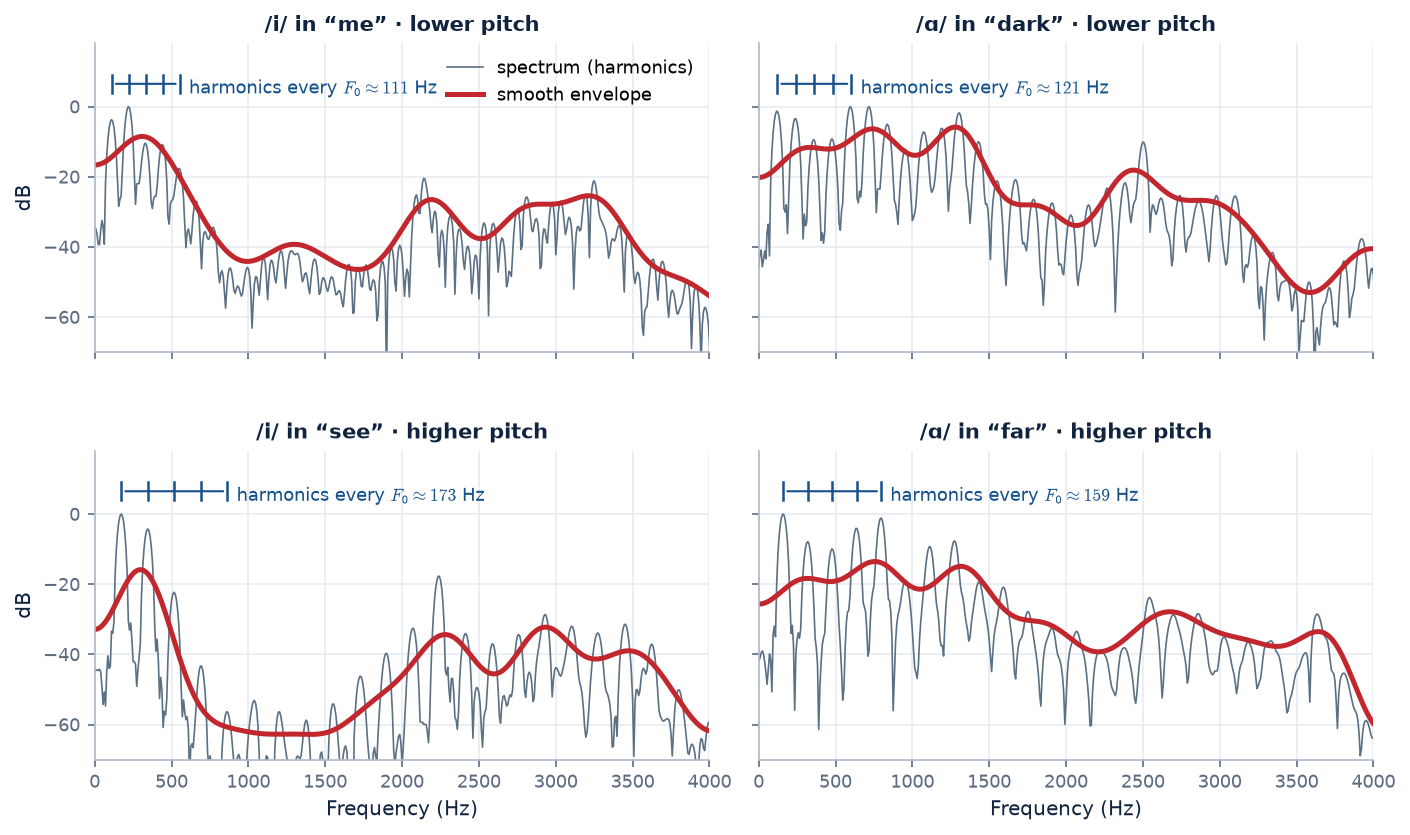
Here is one speaker, ksp, an Indian-English male speaker from the CMU ARCTIC corpus, saying the vowels /i/ and /ɑ/ in different
sentences. Like everyone, he does not speak on a monotone: his pitch drifts up and down, so we can pick each vowel once where his pitch was lower
and once where it was higher. For each we show a 40 ms spectrum from the middle of the vowel, with its smooth envelope drawn on top.
Figure 2. Real speech, 2 × 2, one speaker. Read down a column (same vowel, different pitch): the harmonic lines spread further apart
when his pitch is higher (/i/: \(F_0 \approx 111 \to 173\) Hz; /ɑ/: \(\approx 121 \to 159\) Hz), while the envelope keeps its shape. That is the source changing.
Read along a row (similar pitch, different vowel): the harmonic spacing barely moves, but the envelope changes shape completely. /i/ has a low first peak near 300 Hz and a
strong second one above 2 kHz; /ɑ/ has its first two peaks much closer together, near 700 and 1,300 Hz. That is the filter changing. (How the smooth envelope is computed comes later on this page.)
“me” (lower pitch)
“dark” (lower pitch)
“see” (higher pitch)
“far” (higher pitch)
Compare the two /i/ spectra: with harmonics every 173 Hz instead of every 111 Hz, the same envelope is sampled more sparsely, so its shape
is harder to see. Most women's voices (roughly 165–255 Hz) and children's voices (higher still) make this worse. This is a real, practical difficulty
(formant estimation is harder for high-pitched voices), and a direct consequence of “comb × envelope”; Figure 8 below shows it for a 220 Hz voice.
A caveat, stated once
The model is an approximation. The vocal folds and the tract are not perfectly independent: the tract's air loads the folds (source–tract interaction),
the nose adds anti-resonances in nasals, and the tract changes shape during each pitch period. For most purposes, and for everything on this page,
treating source and filter as separate works remarkably well. That is why the model has been the backbone of speech technology for sixty years.
Now let's open up the two boxes, starting with the source.
05 · The source up close
The vocal folds: a tapper made of muscle.
Inside your larynx (the “Adam's apple”), two small folds of tissue stretch across the airway from front to back:
about 1.5–2 cm long in adult men, 1.2–1.5 cm in women. The gap between them is the glottis.
When you breathe, the folds are held wide apart. When you speak a voiced sound, muscles bring them together, and the air from your
lungs does the rest.
Figure 3. Where the source and the filter sit. The vocal folds are low in the throat, at the top of the windpipe. Air from the lungs passes between them.
Everything above them, up through the throat and the mouth to the lips, is the vocal tract (shaded blue): the filter. The tongue and lips change its shape; the nasal cavity
joins in when the soft palate lowers. The animation below zooms in on the folds, seen from the front.
One cycle, four moments
① Closed
The folds touch. Air from the lungs can't get through, so pressure builds up underneath them.
② Blown open
The pressure pushes the folds apart, bottom edge first. A puff of air squeezes through the gap.
③ Sucked shut
Fast air in a narrow gap has low pressure (Bernoulli), and the stretched tissue springs back. The folds snap together.
④ The tap
The airflow is cut off abruptly. That sudden stop sends a sharp pressure kick up into the vocal tract, which rings. Back to ①.
Nothing in your brain fires once per cycle. Muscles set the folds' tension and position, and the oscillation then runs itself on air pressure and elasticity,
the same way a flag flaps in the wind or your lips buzz when you blow a raspberry (or play a trumpet). This is the myoelastic–aerodynamic theory of voicing.
Tighter, thinner folds vibrate faster, giving a higher pitch.
The animation is slowed down more than a hundred times. Watch the three traces on the right. The airflow rises gently as the folds open
but falls off a cliff when they close. Its rate of change is therefore small during opening and a big, sharp negative spike at closure.
That spike is the kick that excites the tract, and the impulse train keeps just that: one impulse per closure.
The vocal tract is excited mainly at the instant of glottal closure, once per cycle. So the simplest useful model of voiced excitation is a train of impulses,
one every \(T_0 = 1/F_0\) seconds: \(e[n] = \sum_k \delta[n - kP]\), with \(P = f_s/F_0\) samples.
Each impulse makes the tract ring with its impulse response, exactly like the tapped slab.
Can we see the taps in real speech?
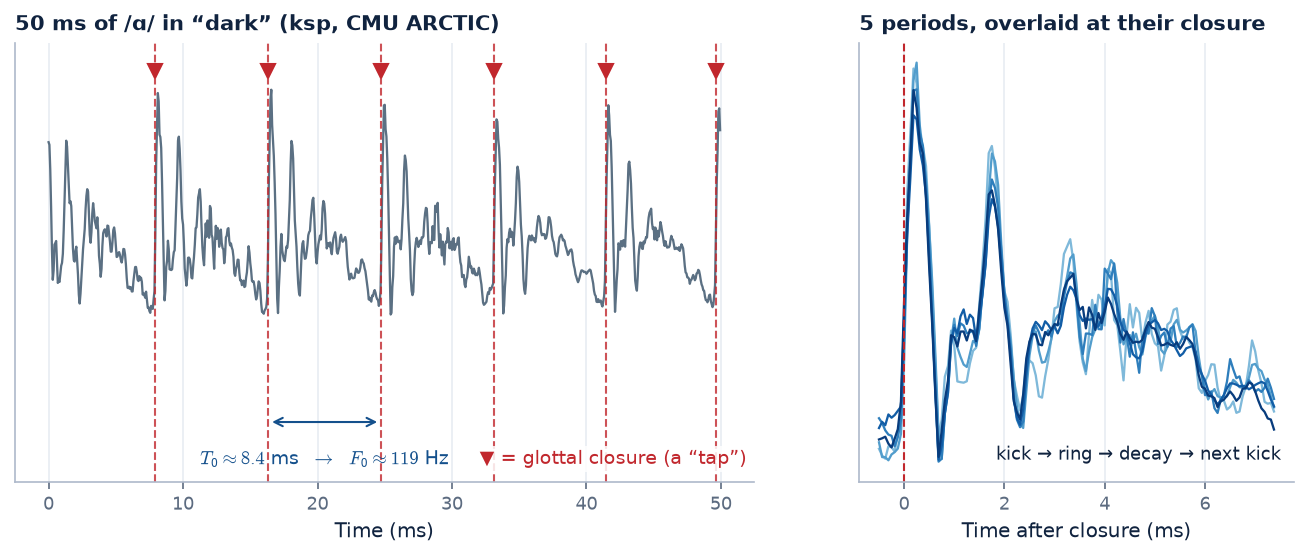
Yes, if we zoom in far enough. Here are 50 ms from the middle of the vowel in “dark” (from “Ah, it is growing dark and darker”), spoken by ksp.
Figure 4.Left: the waveform repeats every 8.4 ms (\(F_0 \approx 119\) Hz). Each period begins with a sharp kick at glottal closure (▼, located automatically,
with the method explained in the AR section). Right: cut the signal at each closure and overlay the periods. They nearly coincide: each is the vocal tract's
impulse response, a kick followed by decaying ringing, restarted by the next tap before it has fully died away.
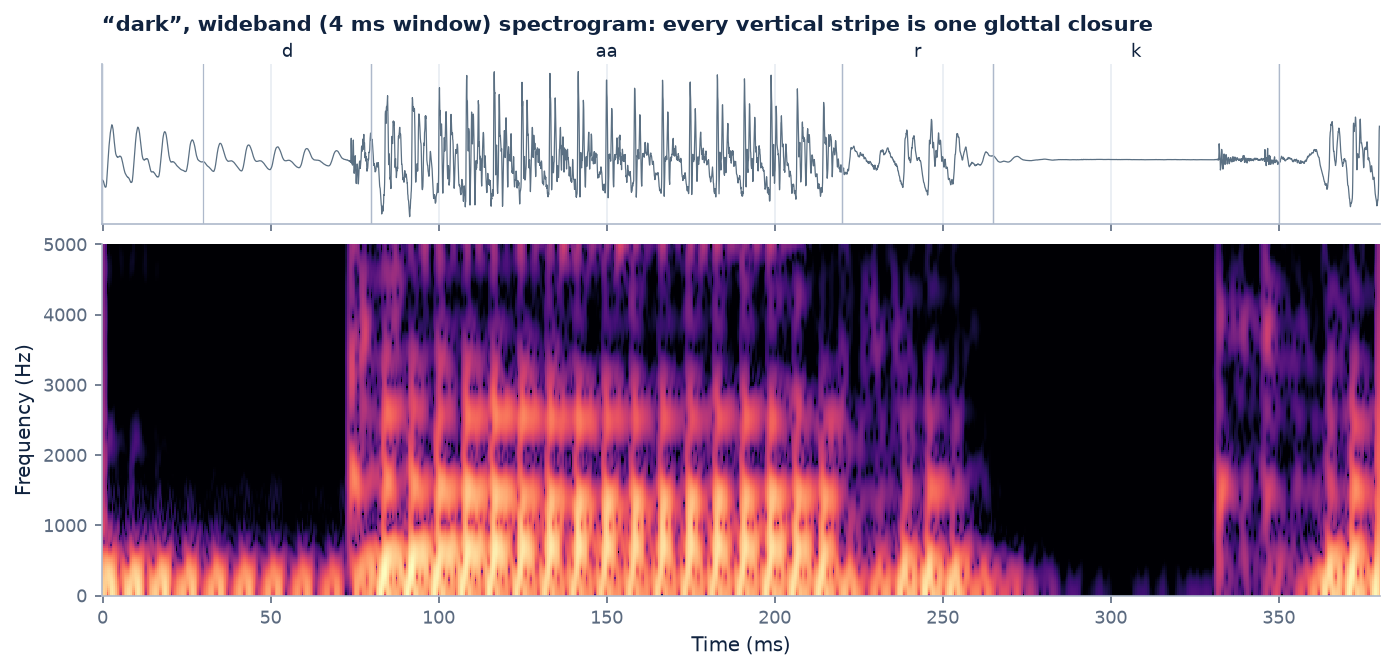
Figure 5. The whole word “dark”, analysed with a very short (4 ms) window. The vowel region is a picket fence of vertical stripes, one per glottal
closure: each tap briefly lights up all frequencies (an impulse is broadband) and the formant regions ring on longest. Count the stripes: about 17 in the 140 ms vowel, i.e. ~120 taps per second.
Compare the d and k releases: a single broadband stripe each, one impulse, not a train. (The faint striped band at the bottom during the d closure is voicing that
this speaker keeps going while the tongue blocks the airflow, a “voice bar”; the phone labels are automatic and approximate.)
“dark” (ksp)
An impulse train in time is a comb in frequency
Why does a periodic source produce harmonics? Any signal that repeats every \(T_0\) seconds can be written as a Fourier series, a sum of
sinusoids at \(F_0, 2F_0, 3F_0, \dots\) and nothing in between. For an impulse train the answer is especially clean: every harmonic has the same strength,
An impulse train in time is an impulse train in frequency, with reciprocal spacing: pulses far apart in time (low voice) give harmonics close together in frequency,
and vice versa. A flat comb is the ideal source for a filter to act on. Every frequency the tract might want to emphasise is available, in equal measure, on the harmonic grid.
Time: first 40 ms
Spectrum, 0–4 kHz - - - −12 dB/octave
Refinement: real glottal pulses are smooth
Real folds don't produce infinitely sharp impulses. The airflow through the glottis is a smooth, lopsided hump each cycle (switch the explorer to realistic glottal pulses).
Its harmonics fall off at about −12 dB per octave: still a comb at exactly the same frequencies, just tilted. We don't need a new model for this.
A smooth pulse train is an impulse train passed through a smoothing filter \(G(f)\):
Since \(G\), \(V\) and \(R\) are all filters, they can be lumped together into one overall filter driven by a flat impulse train. That keeps the source as
simple as possible (just where the impulses are), and it is exactly what the AR model later on will do. The leftover net tilt of about −6 dB/octave is why
speech is usually pre-emphasised (high frequencies boosted slightly) before AR analysis.
Pulse shape also carries voice quality. Folds that close gently and incompletely give smooth pulses and a breathy voice. Folds that slam shut give sharp
closures, stronger high harmonics and a pressed, tense voice.
And the tapping rate is not constant. \(F_0\) rises and falls through every sentence: that is intonation (a question rises at the end, a statement falls). The model
handles this simply by letting \(T_0\) change from one short frame (~20–30 ms) to the next.
Not every sound is tapped: noise sources
If the folds are held apart and air is forced through a narrow constriction instead, the flow becomes turbulent: a random, hissing pressure fluctuation with no period at all.
That is the second kind of source in the model: noise. It can arise at the glottis itself (/h/, whispering) or further forward, where the tongue or lips narrow
the tract (/s/, /ʃ/, /f/). Voiced fricatives such as /z/ and /v/ run both sources at once.
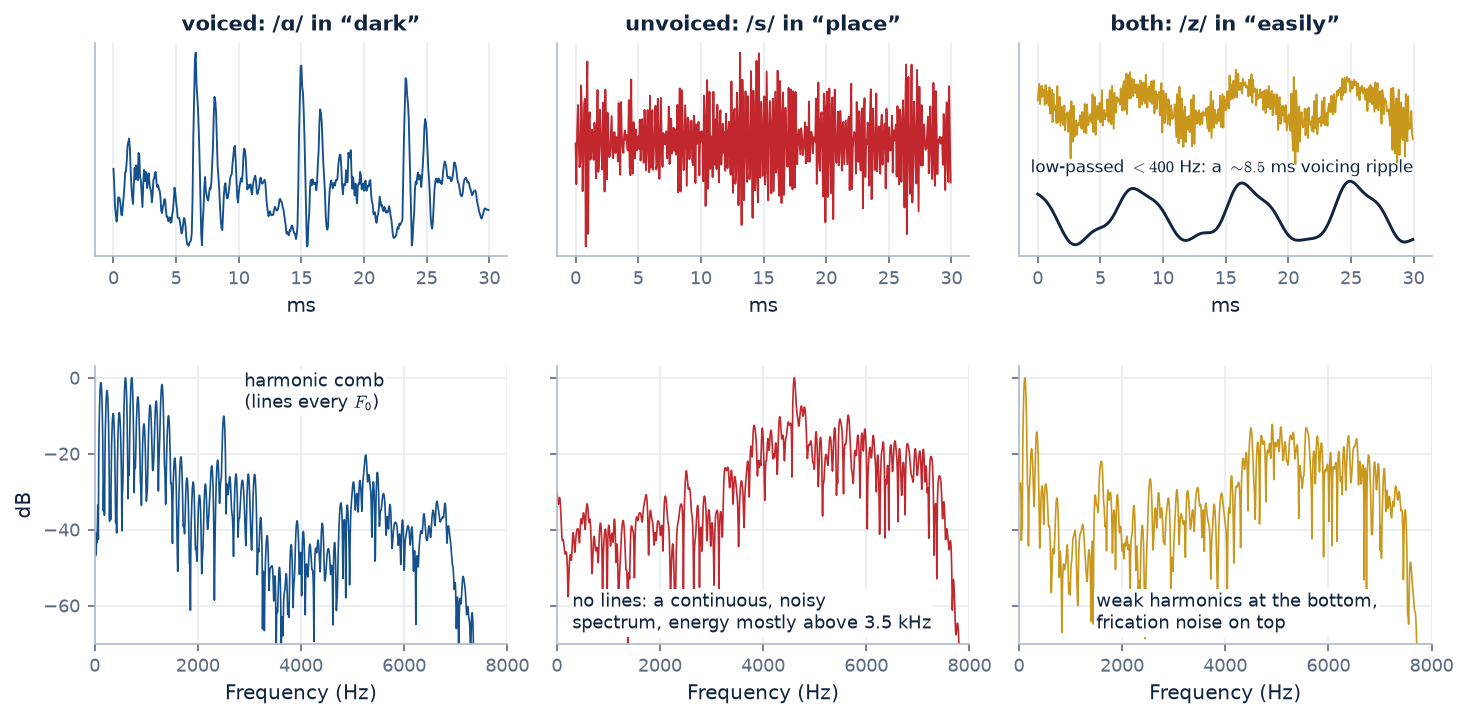
Figure 6. Three sources, one speaker (ksp). /ɑ/ in “dark”: a periodic waveform and a harmonic comb. /s/ in “place”: random-looking waveform, continuous spectrum with no lines,
about 99 % of the energy above 3.5 kHz (the noise is made near the teeth, so only the short cavity in front of it shapes it). /z/ in “easily”: frication noise riding on a slow voicing ripple.
Low-pass it (black trace) and the ~8.5 ms periodicity of the folds shows through.
/ɑ/ (voiced)
/s/ (unvoiced)
/z/ (both)
Isolated phone segments cut straight from ksp's sentences at the (automatic) phone boundaries: they sound clipped out of context, which is part of the point. Real speech is continuous.
Sounds
Source
Where it is generated
vowels, /m n ŋ/, /l r w j/
periodic (impulse train)
glottis
/h/, whispered speech
noise (aspiration)
glottis
/s ʃ f θ/
noise (frication)
a narrow constriction in the mouth
/z ʒ v ð/
periodic + noise
glottis and constriction together
/p t k/ (and /b d g/)
silence, then a single burst (one impulse!)
release of a complete closure
Per short frame, the whole source is described by just three numbers: voiced or unvoiced, the pitch period \(T_0\) (if voiced), and a gain.
Everything else (the vowel, the consonant place, most of the speaker's timbre) lives in the filter. This split is so economical that the classic LPC-10 vocoder
(US standard FS-1015, 1984) sent intelligible speech at 2.4 kbit/s by transmitting just these three numbers plus about ten filter coefficients per frame.
We know what kicks the tract. Next: why it rings where it does.
06 · The filter: resonance and formants
Why things ring where they ring.
Every slab in section 01 rang at its own set of frequencies, and the vocal tract does too. To see where those frequencies come from,
start with the simplest thing that can ring: a weight hanging on a spring.
A mass on a spring
Pull the mass down and let go: it bobs up and down at one particular rate, its natural frequency. The spring pulls it back, its inertia
carries it past the middle, and so on. A stiffer spring pulls harder, so it bobs faster. A heavier mass is more sluggish, so it bobs slower:
$$f_n = \frac{1}{2\pi}\sqrt{\frac{k}{m}}$$\(k\) = spring stiffness, \(m\) = mass: the same two quantities (stiffness and density) that set the slabs' pitch
Friction (damping) makes the bobbing die away. Now do what a child's swing teaches everyone: instead of one pull, keep pushing
it rhythmically, by moving the top of the spring up and down. Try it below. Change how fast you shake it and watch how far the mass swings.
Damping:
What you should find:
Shake slowly and the mass just follows your hand. Shake fast and it barely moves: it can't keep up.
Shake at the natural frequency and each push arrives exactly in step with the motion, adding to it. The swing grows many times larger
than your hand's movement. This is resonance. (It is how a singer can shatter a wine glass, and why soldiers break step on bridges.)
With light damping the resonance peak is tall and narrow: you have to hit the rate precisely, but then the response is huge. With heavy damping it is low and broad.
Kick it once (with the shaking stopped) and it rings at its natural frequency, dying away at a rate set by the damping. That decaying ring is its impulse response.
A resonator has two equivalent descriptions, a Fourier pair. In time, its impulse response is a decaying sinusoid at the natural frequency.
In frequency, its frequency response (the resonance curve) is a peak at the natural frequency. How fast the ring decays sets how wide the peak is:
long ring, sharp peak (steel); short ring, broad peak (wood). The width is called the bandwidth, and
\(\text{bandwidth} \approx 1/(\pi \tau)\), where \(\tau\) is the time for the ring to decay by a factor of \(e\).
Keep that formula in mind for a moment. A typical vocal-tract resonance has a bandwidth of 50–150 Hz, which means it rings for only
\(\tau \approx 2\text{--}6\) ms. That is exactly what Figure 4 showed: each glottal kick rings and has largely died away before the next one, about 8 ms later.
Air is a spring, too
A column of air has both ingredients of a resonator. It has mass (air is light, but not weightless) and it is springy (squeeze it and it pushes back).
So an air-filled tube resonates, and that is how every wind instrument works. Blow across the top of a bottle and you hear its resonance. Pour in some
water to shorten the air column and the note goes up. Your vocal tract is a bent tube of air about 17 cm long, so it has resonances too, and
those resonances are the formants.
The vocal tract as a tube, one step at a time
Why should a 17 cm tube ring at 500, 1500 and 2500 Hz, and not at any other frequencies? We'll build the answer in small steps, starting from bathtime,
and let the formula fall out of a picture at the end.
Step 1 · Air in a tube sloshes, like water in a bathtub
Sit in a bathtub and rock back and forth. If you rock at just the right speed, the water sloshes higher and higher, and it slops over the edge. Rock at any
other speed and the waves stay small and messy. The tub has its own favourite sloshing rhythm, set by its size: a small basin sloshes quickly, a big tub slowly.
The air inside a tube behaves the same way. It can slosh back and forth along the tube, and it has its own favourite rhythms, again set by the tube's size.
For a tube the size of your vocal tract, those rhythms are hundreds of times a second: they are audible tones. Blow across a bottle and you hear one
of them. Those favourite rhythms are the resonances, the formants. The only question is: which rhythms does a tube like best?
Step 2 · The two ends set the rules
The answer depends entirely on what happens at the two ends of the tube. Our tube has two very different ends:
The glottis end is closed: a wall
The vocal folds are shut for part of every cycle, and even when open the gap between them is tiny compared with the tube, so the bottom of the tube acts like a wall. Air pressed against a wall can't move back and forth: there is nowhere to go.
Rule 1: the air right at the glottis stays still.
The lips end is open: free
At the open mouth nothing holds the air back, so it can swing in and out more freely than anywhere else in the tube.
Rule 2: the air at the lips moves the most.
Picture a line of children holding hands down a corridor that has a wall at one end and an open door at the other. The child with their back against the wall can't sway
at all. The one at the open door can swing the furthest. Everyone in between sways a little more the closer they are to the door. The air in the tube follows the same rules.
Step 3 · Which wave shapes obey both rules?
When the air sloshes at a steady rhythm, the amount it swings changes smoothly along the tube in the shape of a wave. So we ask: what piece of a wave starts at
zero (still, at the glottis) and ends at its biggest swing (at the lips)? Try the simplest pieces one by one. The curve in each tube below shows how far the air swings at each point.
Figure 7. Only odd quarters of a wave fit. A wave goes from zero to its peak in one quarter of its length. After three quarters it is at a peak again
(the other way), after five quarters again, and so on. Half a wave or a whole wave ends back at zero: the air would be still at the lips, which only happens if the lips were
closed too. (A tube closed at both ends does fit halves and wholes; that's a different instrument.)
So the tube's favourite waves are the ones that fit \(\tfrac14, \tfrac34, 1\tfrac14, \dots\) of a wavelength into its length \(L\):
$$L = \tfrac{1}{4}\lambda, \quad L = \tfrac{3}{4}\lambda, \quad L = \tfrac{5}{4}\lambda, \quad \dots$$\(\lambda\) (lambda) = wavelength, the length of one full wave
Step 4 · From wavelength to frequency
One more fact: sound travels through warm air at \(c \approx 350\) m/s, and for any wave, \(\text{speed} = \text{wavelength} \times \text{frequency}\). So a frequency is just the speed
divided by the wavelength, \(F = c/\lambda\). Turn each fitting wave into a frequency:
Fits
so the wavelength is
frequency \(F = c/\lambda\)
for \(L = 17.5\) cm
\(L = \tfrac14\lambda\)
\(\lambda = 4L = 70\) cm
\(1 \cdot c/4L\)
\(F_1 = 500\) Hz
\(L = \tfrac34\lambda\)
\(\lambda = 4L/3 \approx 23\) cm
\(3 \cdot c/4L\)
\(F_2 = 1500\) Hz
\(L = \tfrac54\lambda\)
\(\lambda = 4L/5 = 14\) cm
\(5 \cdot c/4L\)
\(F_3 = 2500\) Hz
Every row has the same shape, an odd number times \(c/4L\), so we can write them all at once:
A tube closed at one end and open at the other prefers waves that fit an odd number of quarter-wavelengths, so it resonates at \(c/4L\) and 3, 5, 7… times that.
Longer tube → longer waves fit → lower formants. That is why men, women and children have different formants for the same vowel, and why a child's voice sounds
“small” even when it isn't high-pitched.
Step 5 · Watch it, and hear it
Below, each dot is a little parcel of air. Pick a resonance and watch: the parcels by the glottis barely move, and those at the lips swing the most. For \(F_2\) and \(F_3\) you'll also
see still points inside the tube, where the wave passes through zero. Change the tube length and the formants follow the formula.
Show resonance:
What you hear is the neutral vowel /ə/, the “uh” in “about”: the sound of a tract that hasn't been shaped at all. Shorter tube, higher formants (and here also a higher pitch, as for a real child).
For the curious: the same answer from echoes (optional)
There is a second way to reach \(c/4L\), by timing an echo instead of fitting waves. It needs one extra fact from acoustics: a pressure pulse bounces off a closed end
unchanged, but bounces off an open end inverted (a burst of high pressure comes back as a dip of low pressure, because the air it pushes out of the mouth overshoots
into the room). Follow one pulse: out to the lips (inverted), back to the glottis (unchanged), out to the lips (inverted back), back to the glottis. After four trips
of length \(L\) it is exactly where it started, so the ringing repeats every \(4L/c\) seconds: \(F_1 = c/4L\), the same result. Red is high pressure, blue is low.
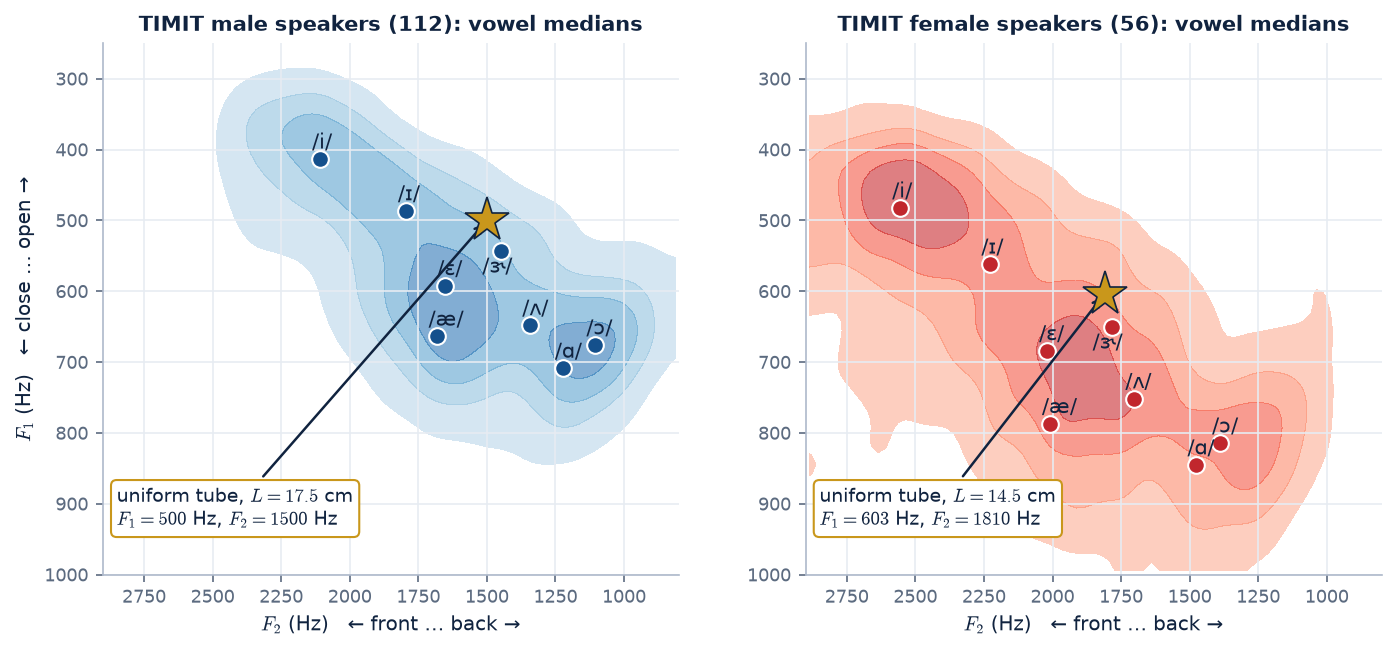
Does the uniform tube match real speech? A uniform tube is the average tract shape. Every real vowel bends it one way or another, so its formants should sit
near the middle of the vowel space. They do:
Figure 8. \(F_1\) and \(F_2\) measured on 8,622 vowels from all 168 speakers of the TIMIT test set (112 men, 56 women), shown only as aggregates: the shading is the density of
all measured tokens, the dots are the median of each vowel. The ★ is the uniform-tube prediction, with no fitting at all: 500/1500 Hz for
a 17.5 cm male tract and 603/1810 Hz for a 14.5 cm female one. It sits in the middle of each speaker group's vowels. The female vowel space is shifted as a whole towards
higher frequencies because the tube is shorter. This is why the same vowel has different formant values for different speakers, and why speech recognisers normalise for it.
Real tracts aren't uniform: glue tubes together
Your vocal tract is not a straight pipe of constant width. The throat is wide in some places and narrow in others, the tongue bulges into it, and the lips can nearly close.
The standard trick for modelling that shape is beautifully simple: approximate it by a chain of short tubes, each with its own width, like a pipe built from
pieces of different diameters.
What happens at a joint between a wide piece and a narrow one? It is a partial wall. Some of the pulse passes through and some echoes back. The bigger the change in
width, the stronger the echo:
$$\text{reflection at a joint:}\quad r = \frac{A_1 - A_2}{A_1 + A_2}$$\(A\) = cross-sectional area; equal widths → \(r = 0\), no echo; a closed wall is the extreme case
In a uniform tube, sound only bounces off the two ends. Now it also bounces, a little, off every joint, so the sloshing patterns that fit are different. Each vowel's pattern of wide and narrow pieces creates
its own resonances. Build some vowels yourself below: drag each piece up or down to change its width. The formants are recomputed from the echoes at every joint.
Frequency response of this chain of tubes (0–4 kHz)
Formants
Notice how little it takes. Two pieces, a narrow one behind a wide one, already sound like “ah”; flip them and you are heading towards “ee”. Linguists and engineers
have used these two- and three-tube models since the 1960s (Fant's work) to reason about vowels with pencil and paper. The more pieces you use, the closer you get to a real
tract shape. The virtual vocal tract below simply uses 34 thinner slices and lets a “tongue” shape them for you.
Keep this picture in mind for the next section. A chain of tube pieces, with an echo at every joint set by \(r\), turns out to be mathematically the same thing
as the AR (all-pole) filter we are about to build. The coefficients that linear prediction estimates from a recording can be converted directly into those reflection coefficients:
from sound alone, you get a rough estimate of the tube's shape.
Shaping the tube: how vowels are made
When you raise your tongue, drop your jaw or round your lips, the tube is no longer uniform: it gets narrow in some places and wide in others. Its resonances move, and
different vowels come out. Three rules of thumb cover most of it:
Narrow at the front
Tongue high and forward, as in /i/ “ee”. The back cavity gets large, the front one small. \(F_1\) falls, \(F_2\) rises.
Narrow at the back
Tongue low and pulled back into the throat, as in /ɑ/ “ah”. \(F_1\) rises, \(F_2\) falls. Open vowels have high \(F_1\).
Round the lips
Pouting lengthens the tube and narrows its opening, as in /u/ “oo”. All formants fall, \(F_2\) especially.
(The general principle, from acoustic perturbation theory: narrowing the tube where a resonance's air velocity is greatest lowers that resonance, and narrowing
it where the pressure swing is greatest raises it. Each formant has its own pattern of velocity and pressure maxima, which is why one tongue movement can push \(F_1\) and \(F_2\) in opposite directions.)
Four real vowels: mouth shape, waveform, spectrogram
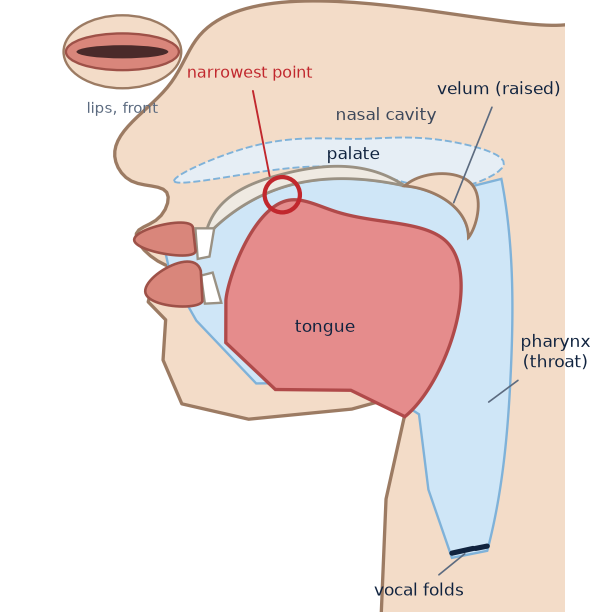
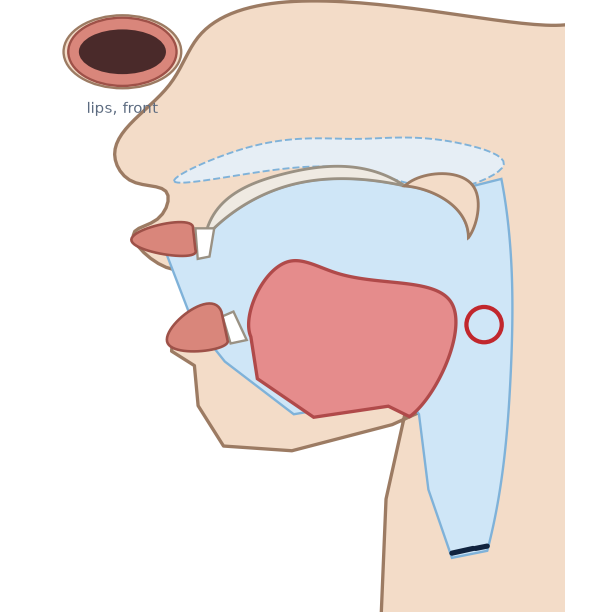
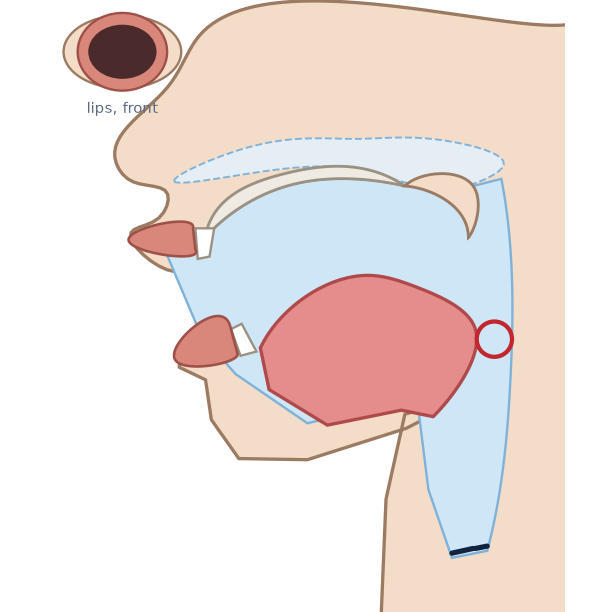
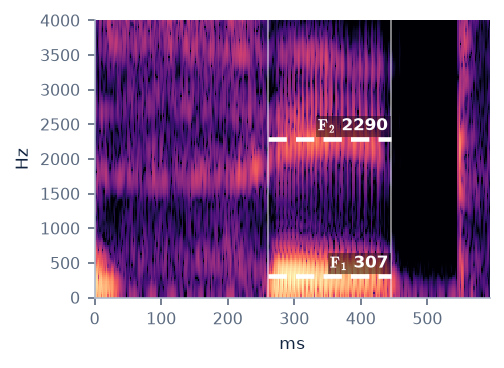
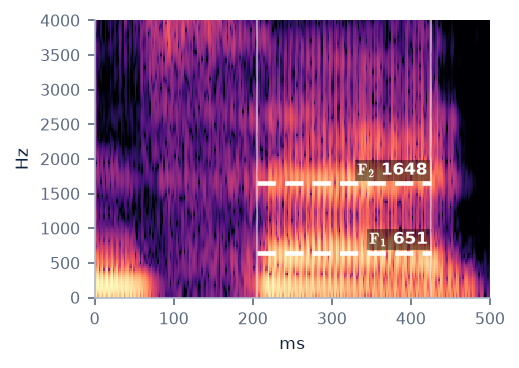
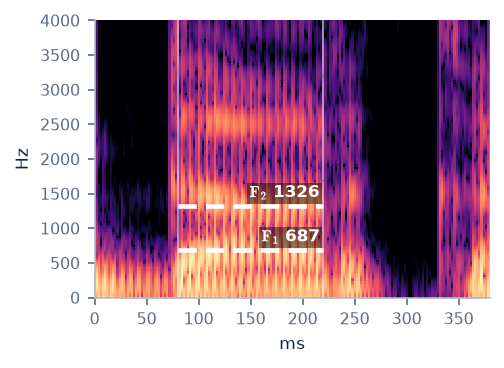
Here are the rules of thumb in action on four vowels spoken by one speaker (ksp, CMU ARCTIC). Each column is one vowel. Read it top to bottom: how the mouth is shaped,
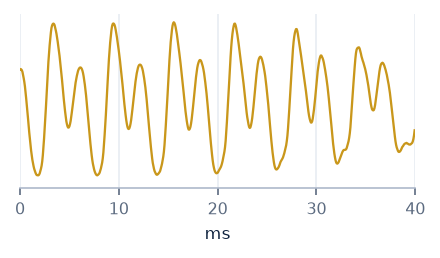
what the waveform looks like (40 ms from the middle of the vowel), and where the energy sits in the spectrogram of the whole word, with
\(F_1\) and \(F_2\) measured and marked. The four vowels sit at the corners of the vowel space, so their shapes and formants differ as much as vowels can.
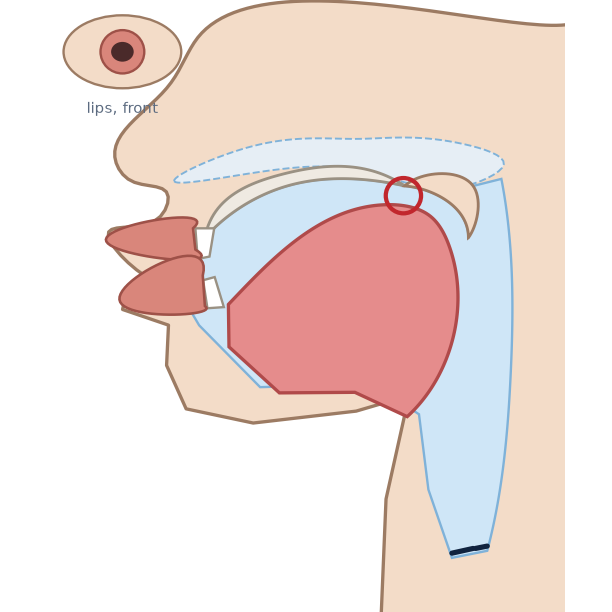
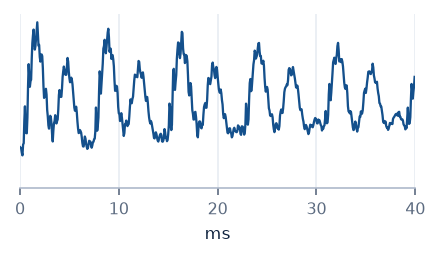
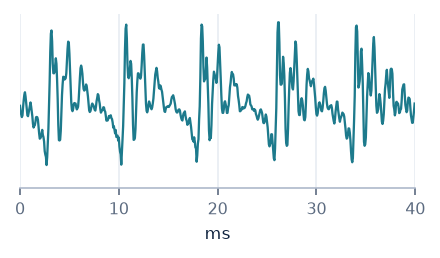
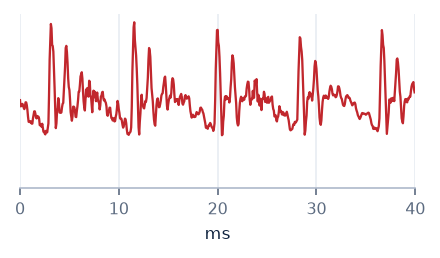
How to read the sketches: the head faces left. Blue is the air inside the vocal tract, the “tube” from the vocal folds to the lips; the pink shape is the tongue; the red circle marks where the tube is narrowest. The small oval at the top left is the lips seen from the front. The nasal cavity (dashed) is shut off by the raised velum for all four vowels. The sketches are schematic: they show the tongue, jaw and lip positions textbooks give for these vowels, not measurements of this speaker.
/i/ “seat”
/æ/ “sad”
/ɑ/ “dark”
/u/ “two”
Mouth shape (side view, sketch)
tongue high & front, lips spread
tongue low & front, jaw open
tongue low & back, jaw wide open
tongue high & back, lips rounded
Waveform (40 ms)
Spectrogram (word, 0–4 kHz)
Formants & audio
\(F_1 \approx 310\) · \(F_2 \approx 2290\)
\(F_1\) low, \(F_2\) high: far apart
\(F_1 \approx 650\) · \(F_2 \approx 1650\)
\(F_1\) high, \(F_2\) fairly high
\(F_1 \approx 690\) · \(F_2 \approx 1330\)
\(F_1\) high, \(F_2\) low: closer together
\(F_1 \approx 320\) · \(F_2 \approx 810\)
\(F_1\) low, \(F_2\) low
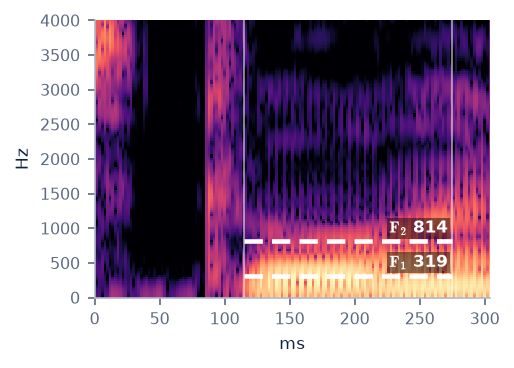
Sketches use the same articulatory presets as the vocal-tract demo. Spectrograms use a short (6 ms) window so formants show up as bright bands; thin white
vertical lines mark where the vowel starts and ends, the dashed lines show \(F_1\) and \(F_2\), and their values are measured automatically (with the AR method of the next section) at the vowel's middle.
What to look for:
Down each column, one tract shape gives one waveform shape and one pair of formant bands. The shape of the tube is written into the sound.
Tongue height ↔ \(F_1\). The high-tongue vowels /i/ and /u/ both have a low \(F_1\) (about 310–320 Hz). The low-tongue, open-jaw vowels /æ/ and /ɑ/ have a high \(F_1\) (650–690 Hz).
In the waveforms, /ɑ/'s strong, fast \(F_1\) ringing is obvious, while /i/ is a slow wave with fine high-frequency ripples on top (its high \(F_2\)).
Tongue front/back ↔ \(F_2\). The front vowels /i/ and /æ/ have a high \(F_2\) (about 1650–2290 Hz), and the back vowels /ɑ/ and /u/ a low one (810–1330 Hz).
In the spectrograms you can see \(F_1\) and \(F_2\) far apart for /i/ and much closer together for /ɑ/ and /u/.
Formants move. Look at the edges of the vowels in “sad” and “dark”: the bands bend into and out of the vowel as the tongue travels from and to the consonants.
Those glides (formant transitions) are how listeners hear which consonant is next to the vowel.
A note on accents: this speaker's /u/ in “two” has \(F_2 \approx 810\) Hz, right at the textbook back-vowel value (~870 Hz for Peterson & Barney's men). Many American English speakers
pronounce the same vowel with the tongue further forward after /t/ and /s/ (“/u/-fronting”), with \(F_2\) well above 1,000 Hz. Formant values are properties of a speaker and an accent,
not of the vowel symbol, and the phone labels used here come from an automatic aligner with an American-English pronunciation dictionary.
Try it below. It is the same chain-of-tubes model, now with 34 thin slices shaped for you by a “tongue” and the lips. The formants are computed from the shape, not looked up.
The tube, glottis (left) to lips (right). Height = cross-sectional area.
Frequency response of the tube (0–4 kHz) with its formants
Where that puts you on the vowel chart (reference: average male vowels)
Model details, for the curious: a chain of 34 lossless cylindrical sections (each with its own area) with the glottis end closed and the lip end open, solved exactly in the frequency
domain with a small uniform loss so that the peaks have realistic bandwidths (~70 Hz). Moving the tongue also bunches it, widening the cavity on the opposite side, and pulling it back also opens the mouth (as the jaw drops for “ah”). The sound is
synthesised by weighting each harmonic of a 120 Hz source by the tube's response at that frequency. For the articulatory side of the same story, see the
vocal-tract demo.
Formants are not harmonics
A very common confusion, worth heading off explicitly. Harmonics belong to the source: they sit at exact multiples of \(F_0\) and move whenever the pitch changes.
Formants belong to the filter: they are the peaks of the smooth envelope and move only when the tract changes shape. The harmonics are
the only frequencies actually present in the sound, so they sample the envelope. A formant can sit between two harmonics and still be heard in their relative loudness.
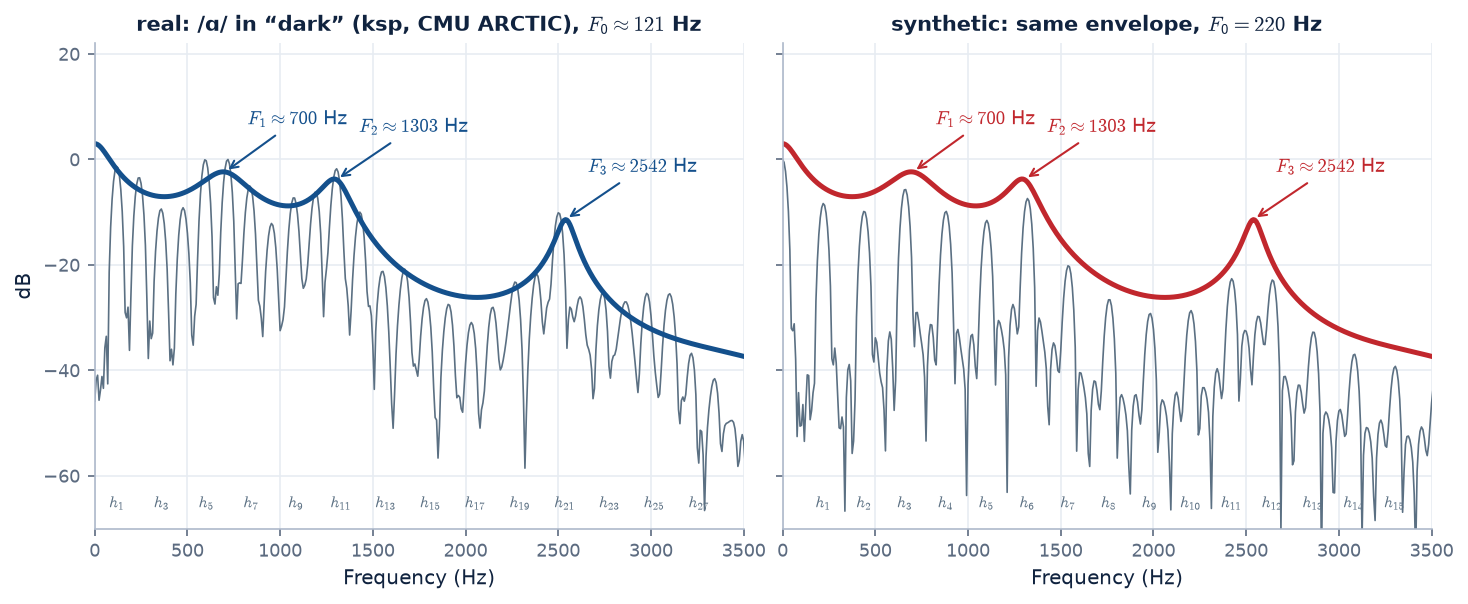
Figure 9. One envelope, two pitches. Left, real: /ɑ/ in “dark” (ksp, \(F_0 \approx 121\) Hz), with the envelope drawn by the AR model of the next section.
\(F_1 \approx 700\) Hz falls between the 5th and 6th harmonics, and with a harmonic every 121 Hz the envelope is densely sampled. Right, synthetic: the same envelope
driven by an impulse train at 220 Hz, a typical adult female pitch (computed, not recorded). Now \(F_1\) lands just above the 3rd harmonic, and there are only about half as many
harmonics to trace the shape. At the high pitches of children and sopranos this gets extreme: some formants fall in a gap between harmonics, which is why trained singers learn to
“tune” a formant onto a harmonic.
The filter of any vowel is well described by its first three or four formants: a frequency for each (where the resonance is) and a bandwidth
(how sharp it is, i.e. how fast it rings down). Each formant is one resonance, a damped oscillator exactly like the mass on a spring. The whole vocal tract behaves like a few such resonators in a row.
What “how fast it rings down” means
Tap a single resonance with centre frequency \(F\) and bandwidth \(B\) and it answers with a decaying sinusoid:
$$h(t) = e^{-\pi B t}\,\cos(2\pi F t)$$
The cosine is the ringing, at the formant frequency \(F\). The factor \(e^{-\pi B t}\) is the envelope that shrinks it, and the bandwidth sets how fast: the envelope drops by a
factor of \(e\) every \(\tau = 1/(\pi B)\) seconds (the same relation as in the resonance key idea of section 06), and by 60 dB, a thousandfold, after about \(6.9\,\tau \approx 2.2/B\).
bandwidth \(B\)
falls by \(e\) every \(\tau\)
down 60 dB after
peak in the spectrum
60 Hz
5.3 ms
≈ 37 ms
narrow, sharp
100 Hz
3.2 ms
≈ 22 ms
250 Hz
1.3 ms
≈ 9 ms
wide, blunt
So a narrow bandwidth means a sharp peak and a long ring (the steel slab); a wide bandwidth means a blunt peak and a ring that dies quickly
(the wood slab). Vowel formants are fairly well damped, with \(B\) roughly 50–150 Hz for \(F_1\) and \(F_2\): the soft walls of the tract, the glottis and the
sound escaping at the lips all soak up energy. That is why each glottal kick has mostly faded before the next one arrives, as the overlaid periods in Figure 4 show.
Coming next: the AR model
How do we capture “a few resonators in a row” with numbers a computer can estimate from a recording? In discrete time, each resonance becomes a pair of poles,
and a filter made only of poles is an autoregressive (AR) model: each speech sample is predicted from the previous few. We'll build it one resonator at a time,
then fit it to real speech. Its prediction error turns out to be the impulse train from section 05.